

Studying abroad is a huge (and honestly, life-changing) decision! But now comes the part that trips up almost every student: which universities do you even apply to? With thousands of programmes across the US, Canada, the UK, and Australia, the process can feel completely overwhelming.
That's exactly where study abroad consultants come in. At Uscholars, we've helped hundreds of students cut through the noise and build a smart, strategic university list. One that balances ambition with realism. In this blog, we're going to show you exactly how to do that for the Fall intake in 2026.
To shortlist universities for fall intake, assess your academic profile, research programme rankings and faculty, categorise universities into Ambitious / Target / Safe tiers, check fall intake application deadlines, and verify English proficiency requirements. Start at least 12–15 months before your intended intake.
Whether you're eyeing a master's degree in the US, a postgrad programme in Canada, or a one-year taught master's in the UK, this guide walks you through everything, from understanding fall intake timelines to avoiding the classic mistakes students make when they shortlist universities.
What Is Fall Intake and Why Should You Care?
The fall intake (also called the September or Autumn intake) is the most popular admissions cycle at universities across the US, Canada, the UK, and Australia. Most universities launch their biggest batch of programmes during this window, which means more seats, more scholarships, and more course options for you. For students planning to study in the US, fall intake is almost always the primary cycle. Most universities do not offer spring admissions for all programmes, especially at the graduate level.
Did you know? Over 70% of international students who pursue a master's degree in the USA enrol during the Fall intake. If you're targeting Fall 2026 admission, your preparation window starts right now. Check our guide on when to begin the application process for more details about the study abroad timeline in 2026.
The fall intake also matters from a career standpoint. In countries like the US and Canada, graduating in May/June (after a fall start) aligns perfectly with internship recruitment cycles at top companies, giving you a real edge in the job market.
Fall Intake by Country: What You Need to Know
Fall intake dates and structures vary depending on the country you're targeting. Here's a quick breakdown:
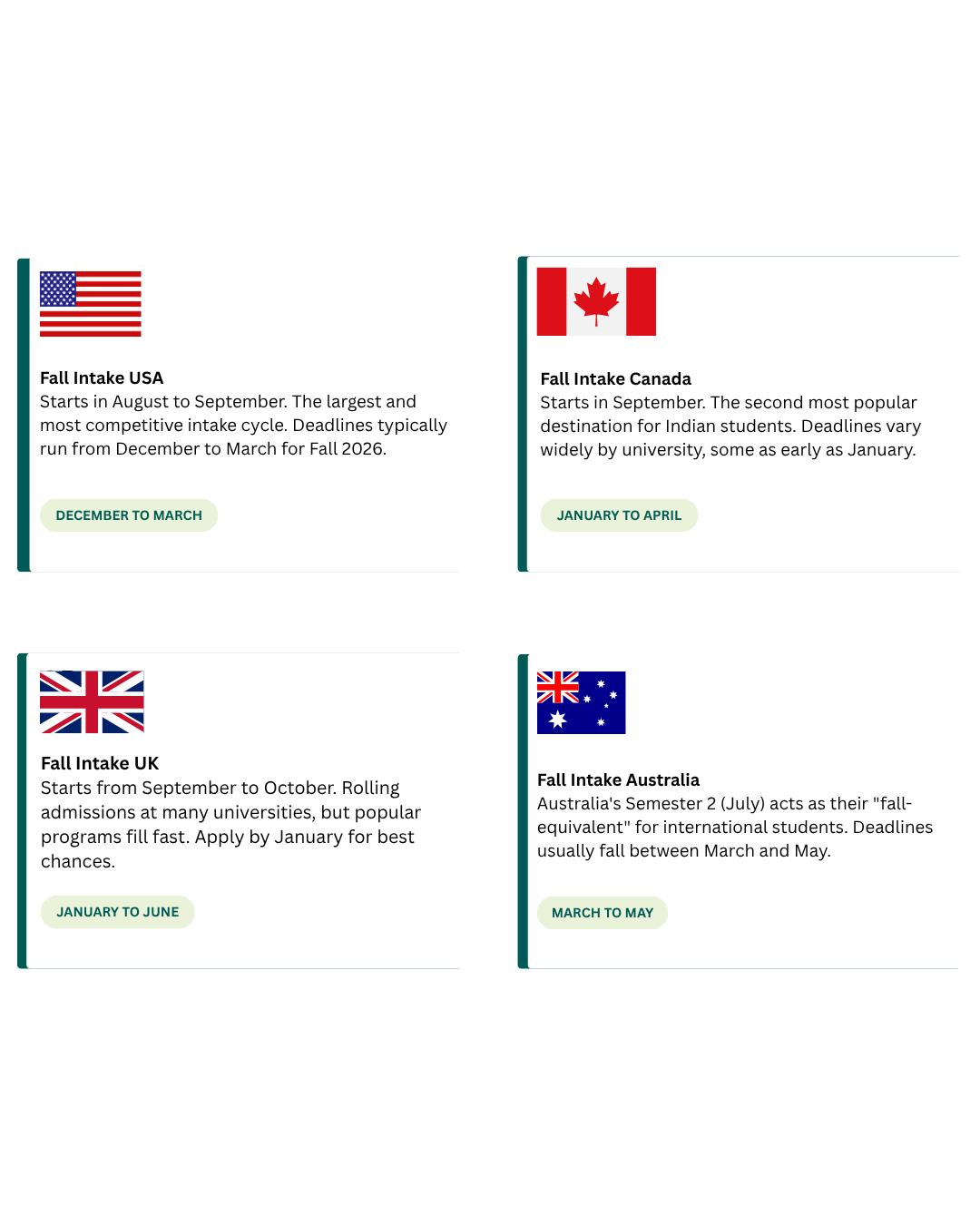
Each of these destinations has its own quirks regarding application requirements, visa timelines, and tuition structures. Knowing where you want to study is the very first decision you need to lock down before you can meaningfully shortlist universities.
How to Shortlist Universities for Fall Intake 2026: Step-by-Step
University shortlisting isn't about picking the highest-ranked schools you've heard of. It's a strategic exercise that matches your profile with programmes that actually want students like you. Here's the framework Uscholars uses with every student:
Build Your Academic Profile Honestly
Your GPA/percentage, GRE/GMAT/IELTS/TOEFL scores, work experience, and research background, lay it all out. This is your baseline. The goal is to find universities where you're competitive, not just eligible. Uscholars provides the complete action plan to ace standardised tests. Check out our guide to tackling the GRE and GMAT exams.
Define What Actually Matters to You
Rankings are not everything. Think about: Which faculty members do you want to work with? Is a co-op/internship programme important? Are you open to smaller cities, or do you want a metro? Does the university have a strong alumni network in your field?
Create Three Tiers: Ambitious, Target, Safe
A balanced list typically has 2–3 ambitious schools (slight reach), 4–5 target schools (strong fit), and 2–3 safe schools (high admit probability). Applying to 12 universities without this structure is a waste of time and money.
Research Admit Statistics (Not Just Rankings)
Look at median GRE scores, average GPA of admitted students, acceptance rates, and class profiles for your specific programme. A university ranked #50 overall might have a top-10 programme in your field, that's the one you want.
Factor in Cost & Scholarships
Tuition is only part of the picture. Check living costs, available scholarships, TA/RA opportunities (especially for a master's degree in the USA), and ROI post-graduation. Some universities offer incredible aid packages, especially in Canada and the UK.
Verify Fall Intake Availability for Your Programme
Not every programme at every university offers a fall intake. This sounds obvious, but students overlook it constantly. Always confirm on the official admissions page before you spend hours writing a Statement of Purpose.
Get a Second Opinion from a Counsellor
Study abroad counselling from an experienced consultant can catch blind spots you won't notice on your own, like a university that's technically a "safe school" but has a 20% visa refusal rate, or a programme that looks great but has no industry placements.
Common Mistakes Students Make When Shortlisting
We've seen hundreds of university lists, and certain mistakes keep popping up. Don't let these derail your fall 2026 admission:
|
Only applying to top-ranked universities |
A rejection from MIT doesn't mean you failed. A smart list wins you options. |
|
Ignoring location and cost of living |
New York and Texas might have the same tuition, but your monthly expenses could differ by $1,000+. |
|
Missing fall intake application deadlines |
Some competitive programmes close as early as December 1st. A week late = a year wait. |
|
Not tailoring your SOP to the programme |
A generic Statement of Purpose is easy to spot. Admissions committees read thousands; yours needs to speak to their specific programme. |
|
Skipping the safe schools |
Overconfidence is real. Always have 2–3 schools where you're a strong candidate. |
|
Forgetting about summer study abroad options |
If you're still in undergrad, summer study abroad programmes can be a great way to experience international education before committing fully. |
|
Not using a university shortlisting tool or consultant |
Going at it alone is harder than it needs to be. Expert guidance genuinely changes outcomes. |
Note: We recommend preparing for and taking the English proficiency exams well in advance.
Fall Intake Application Deadlines: A Quick Reference
One of the most critical aspects of fall intake planning is tracking deadlines across countries and universities. Check out our picks for the best countries for Indian students to study abroad in 2026. Here's a general timeline to bookmark:
Fall Intake Deadlines at a Glance:
- Fall Intake USA: December 1 to March 15 (varies by programme; STEM programmes often earlier)
- Fall Intake Canada: January 15 to April 30
- Fall Intake UK: January 15 (UCAS) for undergrad; February to June for postgrad (rolling)
- Fall Intake Australia (Sem 2): March 1 to May 31
These are general ranges, individual universities often have their own specific fall intake application deadlines. For programmes with funding or scholarships attached, you'll almost always want to hit the earliest possible deadline. Scholarship pools get depleted quickly.
For fall admission, your ideal preparation timeline looks like this:
|
6 to 12 months before the deadline |
Finalise your university shortlist, prepare for standardised tests (GRE/GMAT/IELTS/TOEFL) |
|
4 to 6 months before |
Request recommendation letters, draft your Statement of Purpose |
|
2 to 3 months before |
Complete and submit applications, and apply for scholarships |
|
After receiving offers |
Compare financial aid packages, accept the offer, and begin the visa process |
A Great Application Starts Way Before the Fall 2026 Deadline
Shortlisting universities for fall intake is genuinely one of the most important things you'll do in your study abroad journey. Get it right, and you give yourself the best possible shot at studying at a great school, landing scholarships, and setting yourself up for an incredible career. Get it wrong, apply to the wrong schools, miss deadlines, or build an unbalanced list, and you could end up with zero admits or having to wait another year.
The good news? You don't have to figure this out alone. Whether you're targeting fall intake in the USA, exploring fall intake in Canada, considering the one-year route through fall intake in the UK, or looking at fall intake in Australia, there's a path that fits your profile and your goals.
Start early, build a smart list, stay on top of your fall intake application deadlines, and don't be afraid to ask for help. That's the Uscholars way, and it works.
Book a free 1:1 counselling session with a Uscholars expert. We'll evaluate your profile, build your Fall university list, and map out your entire application timeline, at no cost to you.